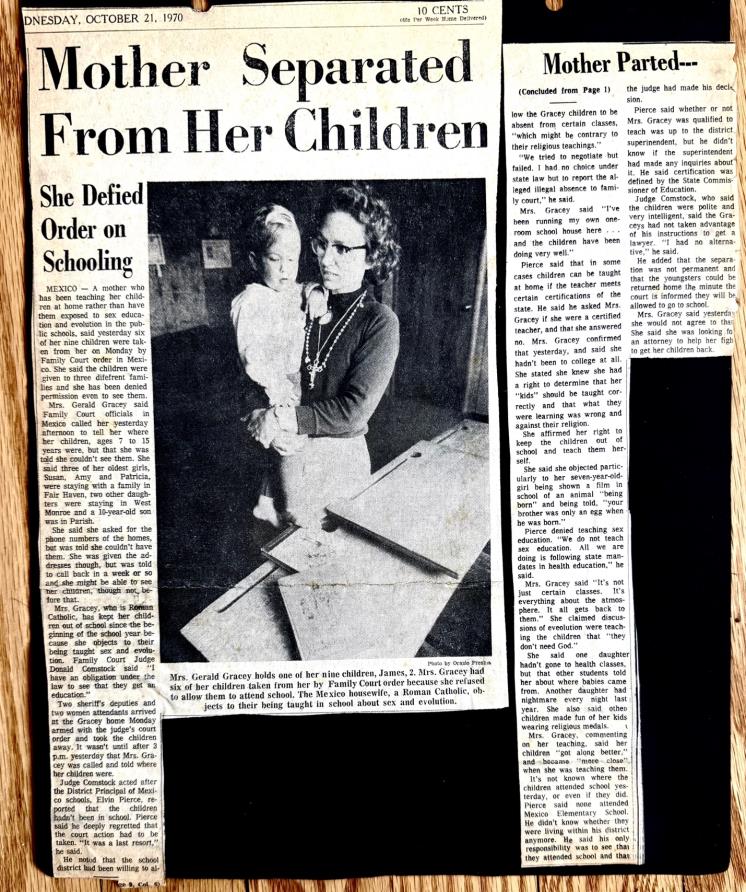
It was a typical crisp fall day that Monday. At approximately 1:00 pm, Jackie showed up in the backroom while I was studying.
"Someone came into the cider mill, and Mom went downstairs to wait on them. But she hasn't come back, and we can hear voices."
I went to the living room with her. At the apartment Dad had built over the cider mill, the living room was over the front part of the store. I could hear loud voices from below but couldn't make them out. I raised my finger to my lips as I opened the door to the staircase and crouched on the landing. I could hear Mom, but there were other voices as well.
I crept back inside. Patty pointed out the window, where we saw two police cars pulling into our driveway. My siblings came and stood next to me, unable to speak as we watched the cops emerge from their cars.
"Do you think they are here to take us away?" Patty asked.
We had discussed this just last Friday, after the judge had threatened to do so if Mom didn't return us to public school. Another family in our district had schooled their children at home and assured us the state never bothered them as long as they fulfilled the requirements set out by the state.
As I watched, I didn't know what to say.
"They can't take us away," Patty fumed. "We are within our rights to study at home."
Feet pounded up the stairs and Mom burst through the door crying, "Go get your father. They are here to take you away."
I've read about moments like this, moments of shock when you deny the event is happening. You seem suspended in air, watching it as though it were happening to someone else. The moment seems unreal. I stood there looking at Mom, but inside my head, deep in my heart, I did not believe her words. I could not accept them. The police were at our house to take us away from our parents? That couldn't happen. Never. Not to us. Not to me.
Like robots, Susie and I jumped into action, running out the back door. I raced toward the apple orchard because Mom had asked us to get Dad. I ran through the rows of trees, trying to locate where Dad was picking.
We found him busy emptying his picking bag into a carefully lined crate. When he first saw us, he smiled, his eyes twinkling with humor. But then he saw our frightened faces and heard us trying to catch our breath.
"What's wrong?" he asked.
We were shouting out the news, the social workers, the police, and Mom's request that he come quickly. He threw his basket down, left his truck, and raced back with us through the trees.
When we walked into the living room, Mom was on the phone. The people at Vers Demain had given her the names of several influential people: Charles Rice, a prominent professor of law at Notre Dame, Dr. William Marra, a professor at Fordham University, and Charles Pulver, a professor at Cazenovia, NY. She called them all, but it was to no avail. All of them said the same thing: once the judge makes the order there is nothing you can do to stop it.
Mom hung up the phone, her face ashen. She glanced at Dad, who stood beside her, rubbing the shadow on his face. The rest of us stood, silent and frozen in place.
Dad broke the silence. "We'd better get the kids downstairs."
"If they want my kids, they will have to come and take them," Mom cried.
Someone downstairs must have heard because immediately we heard multiple feet stomping. As we stood there, people flooded into our living room, surrounding us, three social workers followed by three police officers.
Mrs. Dennison pushed her way through the group. Looking around the living room, she demanded, "Get your coats, if you have any."
Her words triggered something in Dad and he exploded. "You take them, you provide."
With that, Mrs. Dennison signaled us out the doorway. I stared at her and suddenly knew this was real. They were taking us. We were going off with people we did not know, loaded into police cars like criminals, and my parents were helpless. The realization affected each one of us differently. I moved forward in a fog, numb and unable to register what was happening. Patty gathered the little ones under her arms as they headed out.
As I stepped onto the landing, I heard my youngest sister, Kathy, screaming, "Mommy, Mommy! Don't let them take me. Don't let them take me. Mommy! Mommy!"
I heard later that Kathy grabbed onto Mom's skirt, refusing to let go and Mrs. Dennison pried them off one at a time, while snapping at Mom, telling her she was only making it harder. Kathy screamed all the way down the stairs. She was seven years old.
The police dropped us off at the Fire Station in town.
"Thanks for coming to our rescue," Mrs. Dennison called after them as she ushered us down Main Street.
"Call us any time," they replied.
We were herded to the Social Service office, told to stay quiet in the receiving area, and ushered into a narrow closet-like room where there were chairs. For three hours, we sat staring into space. We could hear the social workers laughing and bantering, now and then making a derisive remark about Mom.
I've never forgotten the horror of that day. I've never been able to erase the pain of having social workers corral us into police cars, while the police told my younger siblings to be quiet when they started to cry. I will forever bear the humiliation of sitting for hours in the office while the social workers acted like this was just another normal day, yanking kids from their parents and then playing monopoly to find them foster parents, splitting them up because my goodness, six at one time is way too many.
Finally, the social workers got up from their desks, rushed us across the street to Ramsey's Clothing Store with a list of things we needed, and then divided us into two groups. Patty and I begged to be put with one of the younger siblings, but Mrs. Dennison was adamant.
"No, you will influence the younger ones. You will go to a different home."
I watched with pain in my heart as my younger siblings were urged into the car. I didn't know where they were going. I didn't even know if they would be kept together or further separated. I struggled to keep my composure as the car drove away.